Sebastian Pedalino, Bruno E. Ramírez-Galindo, Richard Ferstl, Klaus Hornberger, Markus Arndt and Stefan Gerlich
Probing quantum mechanics with nanoparticle matter-wave interferometry
Nature 649, 866-870 (2026)
Abstract:
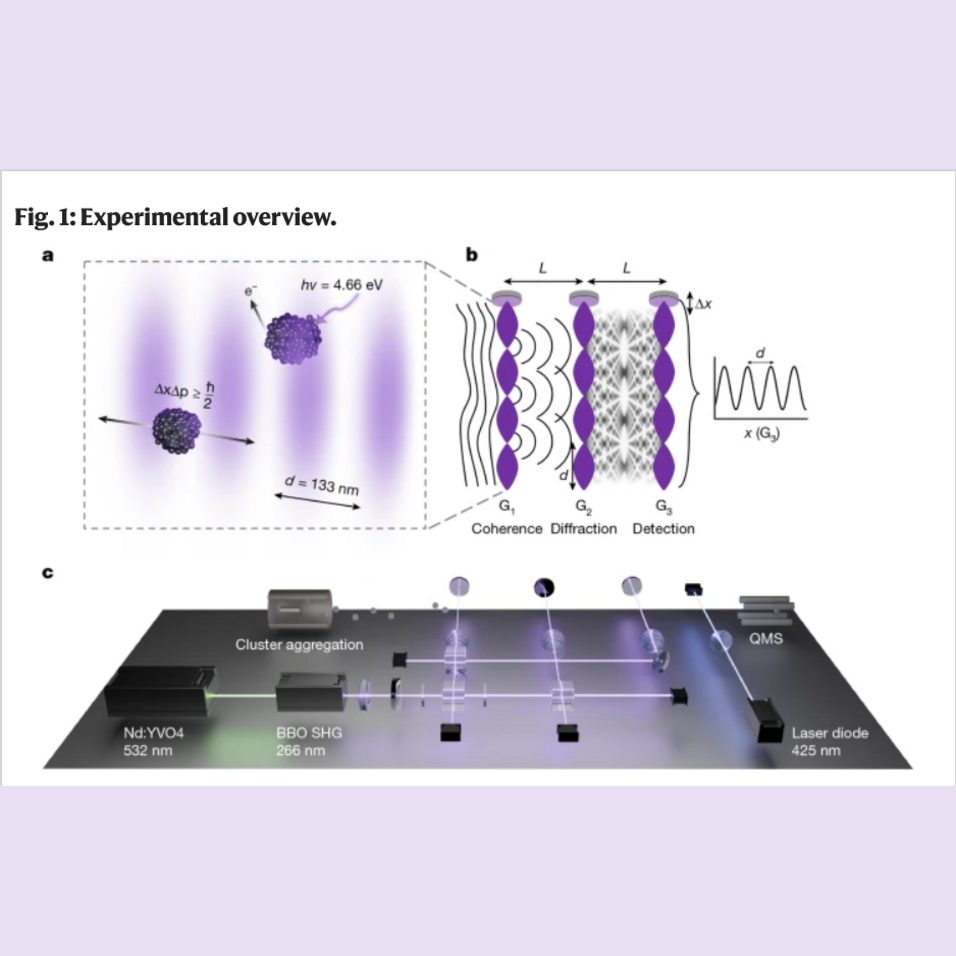
The quantum superposition principle is a fundamental concept of physics and the basis of numerous quantum technologies. Yet, it is still often regarded counterintuitive because we do not observe its key features on the macroscopic scales of our daily lives. It is, therefore, interesting to ask how quantum properties persist or change as we increase the size and complexity of object. A model test for this question can be realized by matter-wave interferometry, in which the motion of individual massive particles becomes delocalized and needs to be described by a wave function that spans regions far larger than the particle itself. Over the years, this has been explored with a series of objects of increasing mass and complexity and a growing community aims at pushing this to ever larger limits. Here we present an experimental platform that extends matter-wave interference to large metal clusters, a qualitatively new material class for quantum experiments. We specifically demonstrate quantum interference of sodium nanoparticles, which can each contain more than 7,000 atoms at masses greater than 170,000 Da. They propagate in a Schrödinger cat state with a macroscopicity of μ = 15.5, surpassing previous experiments by an order of magnitude.
Press release: https://www.univie.ac.at/en/news/press-room/press-releases/detail/metal-clumps-in-quantum-state-vienna-research-team-breaks-records