
Long baseline Universal Matter-wave Interferometer (LUMI)
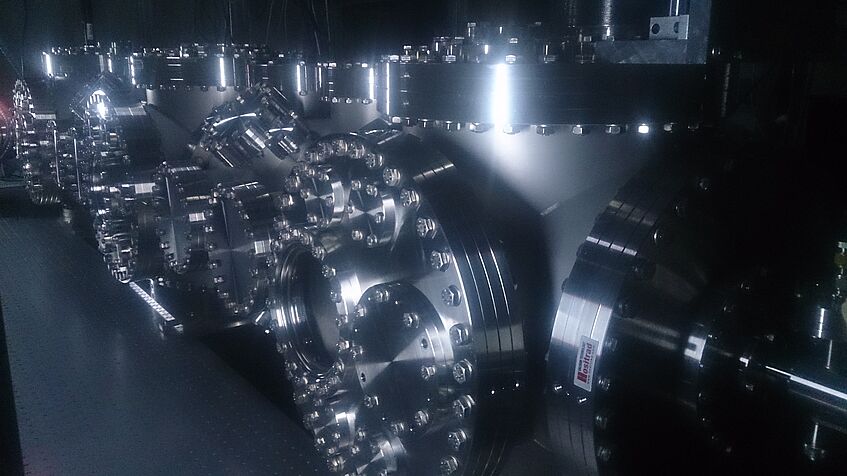
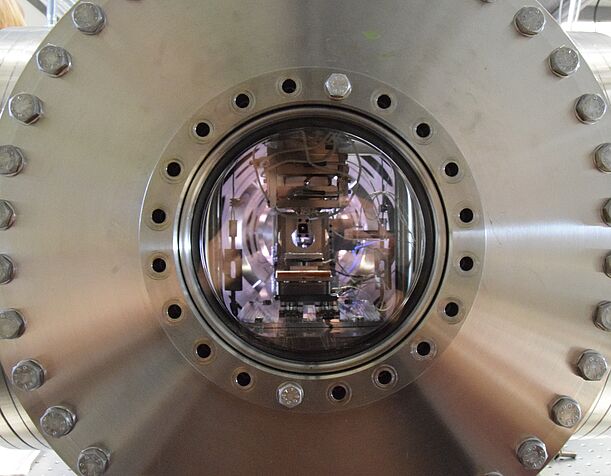
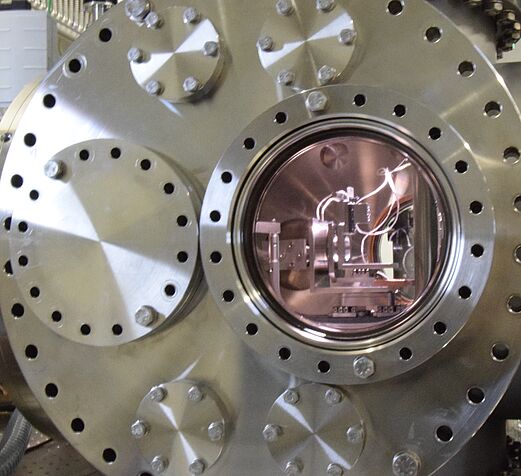
LUMI is based on the KDTLI concept but stretched by 10x to 2 m interferometer length. This increases the acceptance of high mass even at high velocity and with that also de Broglie wavelengths of smaller than 50 fm. Like the KDTLI and OTIMA experiments, LUMI relied on the Talbot-Lau effect, because near-field interference offers a good mass scalability and high signal throughput. LUMI has the unique capability to be operated in two different modes.
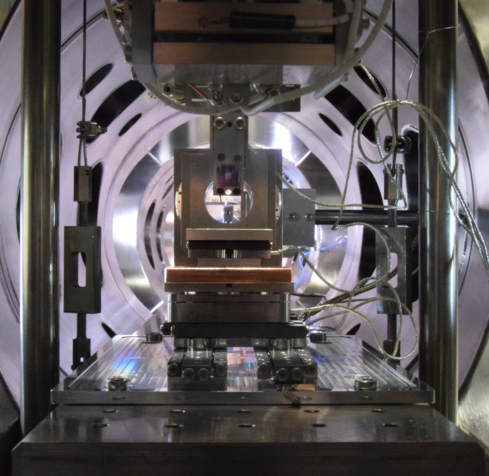
- KDTLI mode: For slow, polarizable molecules we use a nano-mechanical gratings (d = 266 nm) in position G1 and G3 to act as transmission mask for coherence preparation and fringe detection, respectively. The central phase grating G2 is formed by a green standing light wave.
- TLI mode: For fast particles of low polarizability, the second grating G2 can also be swapped in-vacuum for a nano-mechanical grating, identical to those in G1 and G3.
Sources
LUMI was calibrated using thermal sources and EI-QMS mass spectrometry, which are both established and reliable methods for thermally stable molecules in the mass range up to several kDa. It was extended to a laser desorption source for high-mass interferometry. The upgrade, LUMI 2.0 will be connected to a metal cluster source.
Inertial and Vibrational Phase Averaging
The long baseline endows the instrument with high sensitivity to external forces, in particular also to vibrations and to the Coriolis shift caused by the rotation of the Earth. Earth's gravity imposes also stricter alignment requirements than in all previous molecule interferometers. We have found, however, that the gravitational and Coriolis shift can compensate each other in a suitable alignment of the interferometer.
To address the vibrational sensitivity, we have mounted the interferometer on a high-mass (160 kg) INVAR bar suspended from a double pendulum. Springs, teflon balls, and eddy damping brakes provide additional vibrational isolation and damping. A piezo accelerometer on the interferometer bar as well as an optical Mach-Zehnder interferometer operated in parallel with the molecular interferometer give precise readout of grating motions and can also be used in an active feedback scheme.
Grating control
Nanometer-precision SMARACT© piezo motors control shift, roll, and longitudinal displacement of the gratings in LUMI. They allow excellent alignment, reproducibility and a travel range sufficient to interchange material and optical gratings in situ.
Detection
LUMI is equipped with a quadrupole mass spectrometer (QMS) with a cross beam deflector for high-mass resolution with low dark counts and high transmission. The entire detector can be lifted out of the beam-line in favor of other detection methods, such as laser post-ionization TOF-MS or fluorescence imaging.
Successful completion
The experiment confirmed the wave-particle duality for functionalized oligoporphyrins as massive as 25 kDa, setting the macroscopicity world record in 2019 and defining new quantum bounds on the possibility of spontaneous wave function collapse.
The high force sensitivity has been utilized to measure improved of first polarizabilities of organic molecules, as well as diamagentism in atoms and molecules.
Follow-up
The experiment was successfully upgraded to MUSCLE, by substituting all gratings with optical photo-depletion gratings new sources and new detectors, to extend the mass range to beyond 170 000 amu, using sodium metal clusters.
References:
- Y.Y. Fein, S. Pedalino, A. Shayeghi, F. Kiałka, S. Gerlich, M. Arndt,
Nanoscale magnetism probed in a matter-wave interferometer,
Phys. Rev. Lett. 129, 123001 (2022), doi:10.1103/PhysRevLett.129.123001. - Y.Y. Fein, A. Shayeghi, F. Kiałka, P. Geyer, S. Gerlich, and M. Arndt,
Quantum-assisted diamagnetic deflection of molecules
Phys. Chem. Chem. Phys. 22, 14036 (2020), 10.1039/d0cp02211j, PCCP Hot Paper - Y.Y. Fein, A. Shayeghi, L. Mairhofer, F. Kialka, P. Rieser, P. Geyer, S. Gerlich, M. Arndt
https://journals.aps.org/prx/abstract/10.1103/PhysRevX.10.011014Quantum-Assisted Measurement of Atomic Diamagnetism,
Phys. Rev. X 10, 011014 (2020). DOI 10.1103/PhysRevX.10.011014 - Y.Y. Fein, F. Kialka, P. Geyer, S. Gerlich, M. Arndt
Coriolis compensation via gravity in a matter-wave interferometer,
New J. Phys. (2020). DOI 10.1088/1367-2630/ab73c5 - Y. Y. Fein, P. Geyer, F. Kiałka, S. Gerlich, and M. Arndt,
Improved accuracy fullerene polarizability measurements in a long-baseline matter-wave, interferometer,
Physical Review Research 1, 033158 (2019). - Y. Y. Fein, P. Geyer, P. Zwick, F. Kiałka, S. Pedalino, M. Mayor, S. Gerlich, and M. Arndt,
Quantum superposition of molecules beyond 25 kDa,
Nature Physics 15, 1242 (2019). - F. Kiałka, B. Stickler, K. Hornberger, Y. Y. Fein, P. Geyer, L. Mairhofer, S. Gerlich, and M. Arndt,
Concepts for long-baseline high-mass matter-wave interferometry,
Phys. Scr. 94, 034001 (2018).